Liquidity Providing for Beginners: The Other Side of the Counter
What a liquidity pool is, where the swap fee goes and the one risk to understand before your first position, through the two Genesis liquidity quests.
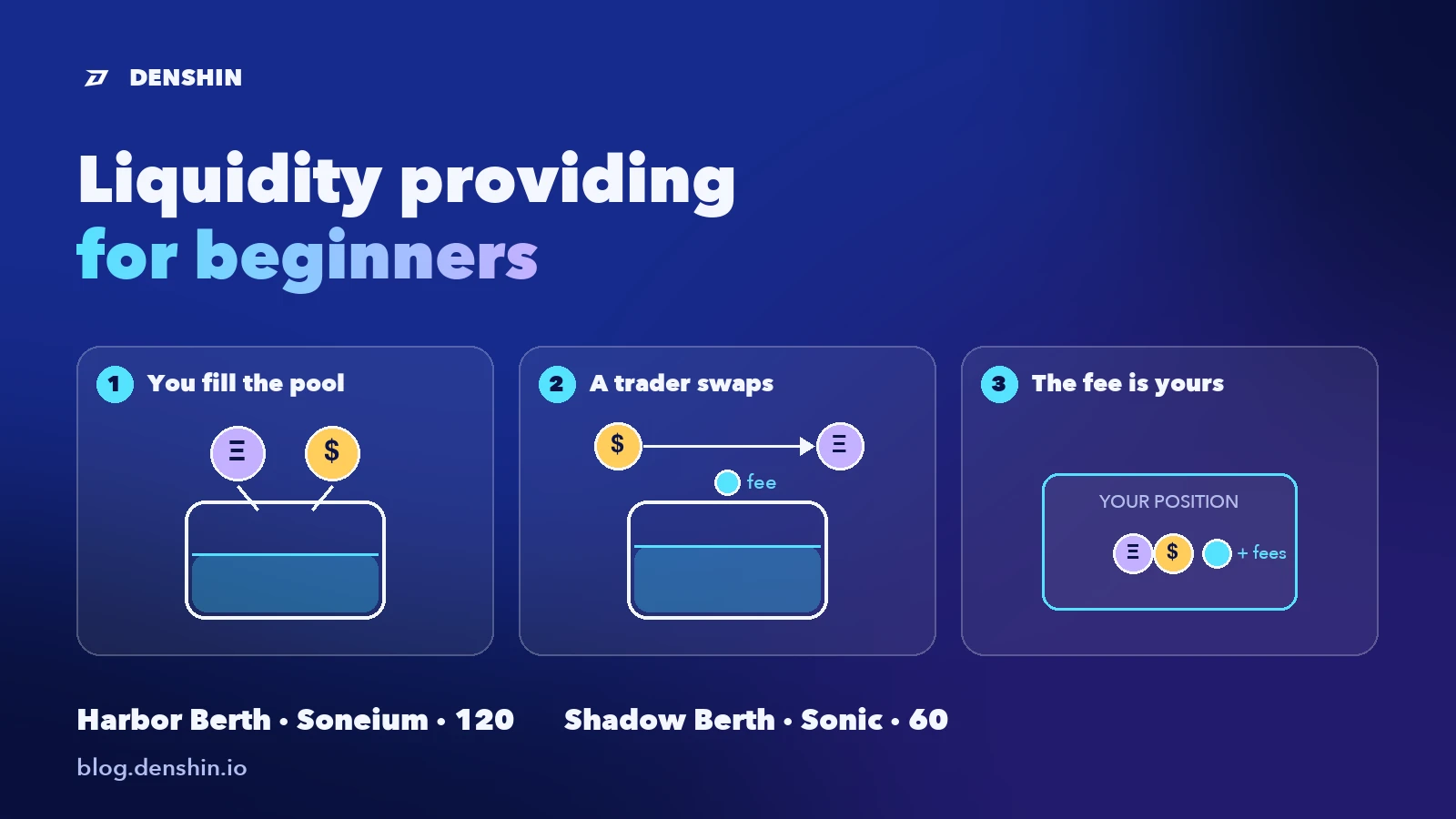
Every swap you've made this season had someone on the other side. You handed over one token, got another back, and paid a small fee for it. That someone, the one who collected the fee, was a liquidity provider.
Two Genesis quests put you in that seat: Harbor Berth on Soneium and Shadow Berth on Sonic. This guide is what to know before you take it.
What a pool is#
Think of an exchange counter that never closes. Behind it sit two drawers, one per token: say, ETH in one and dollars in the other. Anyone can walk up, put dollars into one drawer and take ETH out of the other.
A liquidity pool is that counter, run by a contract instead of a clerk. The drawers are filled by players like you. When you provide liquidity, you put both tokens in, in the proportion the pool asks for, and you get back a receipt: a share of whatever the drawers hold from then on.
Nobody sets the price by hand. It comes from the ratio between the two drawers: the more of one token traders pull out, the dearer it gets.
Where the fee goes#
Each swap through the pool pays a small fee, a fraction of a percent of the trade. The fee stays in the pool, and every provider owns a slice of it in proportion to their share.
That is the whole business model of the counter: traders pay to swap, providers earn for having filled the drawers. A busy pair earns more than a quiet one, and a big share earns more than a small one.
The one risk to understand#
Here is the part most first-timers skip. While your money sits in a pool, its two sides are traded against each other, and the pool always sells the token that is going up.
A simple example. You put in $5 of ETH and $5 of dollars. Then ETH doubles in price.
- If you had just held both, you'd now have $10 of ETH and $5 of dollars: $15.
- In the pool, traders have been buying the cheaper ETH all the way up. You now hold less ETH and more dollars, worth about $14.14.
That gap of about 86 cents is called impermanent loss. It is "impermanent" because it shrinks again if the price comes back to where you started, and it only becomes real when you withdraw at a different price. The fees you earned work the other way, and on a busy pair they can cover it.
The same thing happens if ETH halves: the pool buys it on the way down, and you end up holding more of the token that fell. Pairs whose two sides move together, like two dollar tokens, drift apart much less.
Classic pools and concentrated liquidity#
There are two common designs, and you'll meet both this season.
- Classic pools spread your money across every possible price. Simple, always earning a little, never earning a lot.
- Concentrated liquidity lets you pick a price range. Inside that range your money works harder and earns a bigger slice of the fees. Outside it, your position stops earning and sits entirely in one of the two tokens until the price comes back.
On a concentrated pool, the position is issued to you as an NFT: a receipt with your range written into it.
For a first position, a wide range is the calm choice. A narrow one earns more while the price stays put and leaves the range sooner when it moves.
The two quests#
Both quests check what your wallet holds when you press Verify, not the transaction that opened it. Only your main wallet is read, and nothing asks for an approval to us.
| Quest | Network | Asks for | Points |
|---|---|---|---|
| Harbor Berth | Soneium | A liquidity position on Kyo | 120 |
| Shadow Berth | Sonic | A liquidity position on Shadow | 60 |
Harbor Berth is the best-paid single quest on Soneium. Any Kyo pair counts; the position arrives as an NFT, and one is enough. The quest sets no floor on the amount: a position of a few cents closes it exactly like a large one. Gas on Soneium is paid in ETH, and its dollars carry an .e, which we covered in where to start on Soneium.
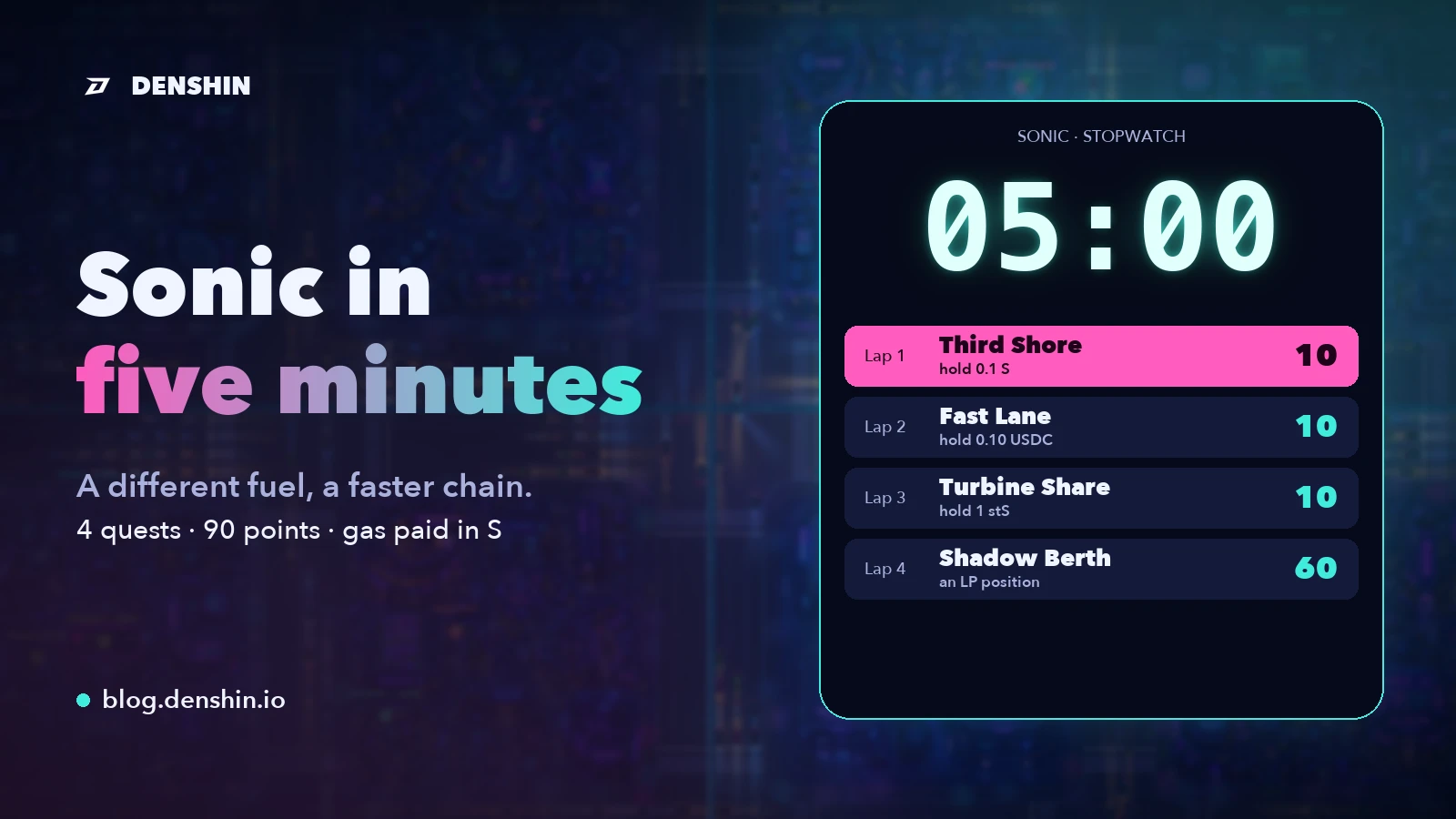
Shadow Berth works the same way on Sonic: any pair, any size, and both classic pools and concentrated liquidity count. Gas there is paid in S, not ETH, so bring a little first. Sonic in five minutes has the rest.
A careful first position#
- Pick an amount you're fine learning on. The quest pays the same for a few cents as for a few hundred dollars.
- Keep gas aside. You will need a transaction to open the position and another to close it later.
- Read the approvals. Adding liquidity asks your wallet to let the exchange move both tokens. The request should name the token and the amount; the spender is the exchange, never us.
- On a concentrated pool, choose a wide range. You're here to learn the mechanic, not to squeeze out fees.
- Leave it in until you press Verify. The check reads the position, so withdraw first and the quest has nothing to find.
One thing these quests don't do#
A liquidity position proves you hold funds, not that you made a move, so neither quest counts as the verified transaction a Genesis payout asks for. A swap quest on Base or Soneium does, and so does a counted Denshin Sync. The rule is on the fair play page.
Try it#
What each check reads is on the Soneium and Sonic pages of our docs. Then open app.denshin.io, find Harbor Berth or Shadow Berth, and take the other side of the counter. Genesis runs until 31 October.