What Our Quests Really Cost a Player in Gas
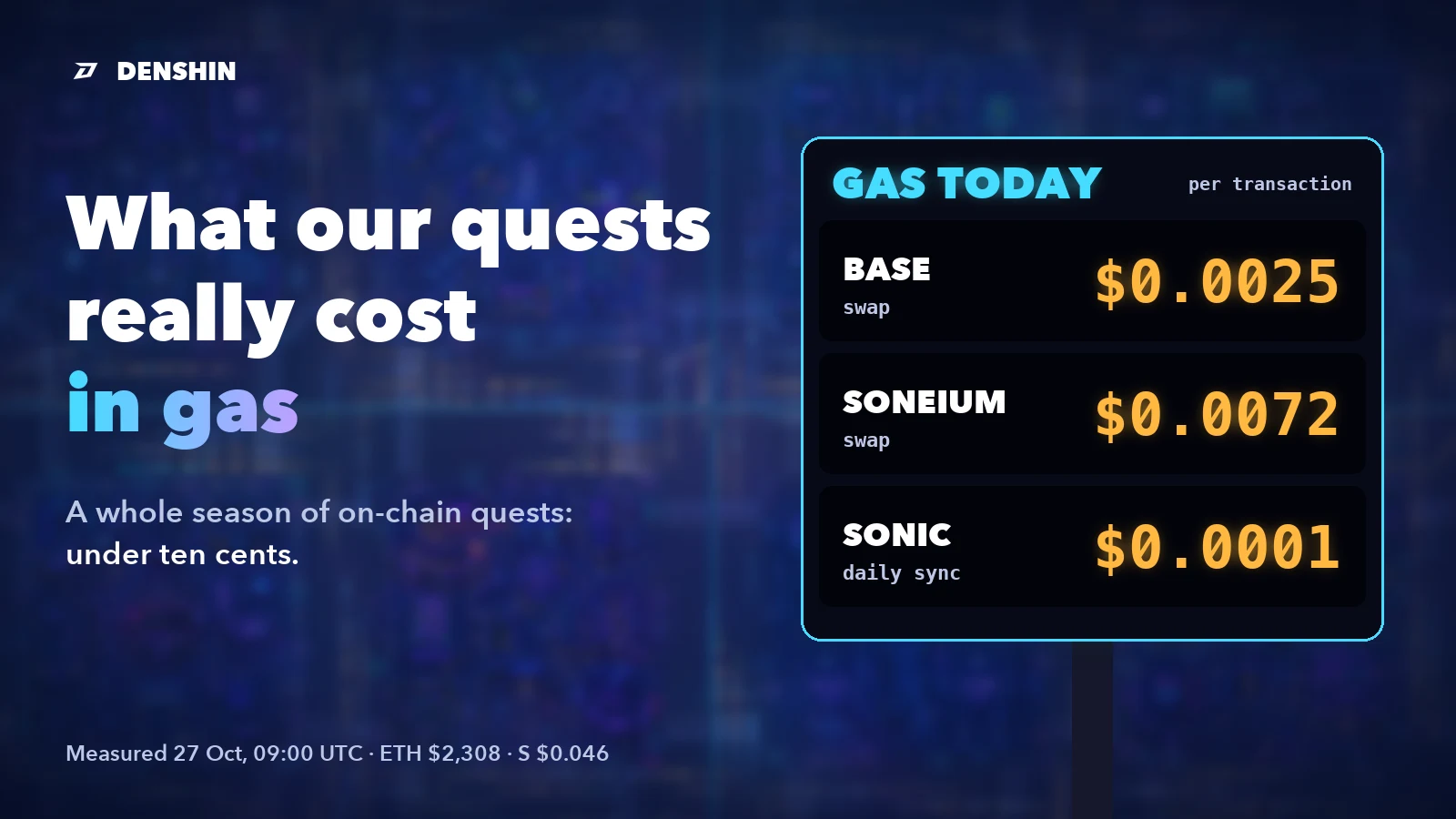
We priced every kind of on-chain quest in Genesis against real transactions on Base, Soneium and Sonic. A whole season comes to under ten cents of gas.
"How much will this cost me?" is the first question a new player asks about an on-chain quest, and the honest answer used to be "it depends". So this morning we measured it.
On 27 October 2026, around 09:00 UTC, we read the live gas price on all three networks of the season and pulled receipts of real transactions made in the hours before: swaps, deposits, liquidity positions and check-ins on our own contract. Then we priced them at that morning's token prices: ETH at $2,308 and S at $0.046.
The short version: every transaction-based quest of Genesis together comes to under ten cents of gas. The gas is rarely the part that costs you anything.
The price list#
| Network | Action | Gas used | Cost |
|---|---|---|---|
| Base | Denshin Sync (daily check-in) | 46,676 | $0.0007 |
| Base | Token approval | ~55,000 | $0.0008 |
| Base | Swap on Uniswap or Aerodrome | 107,000 to 200,000 | $0.0015 to $0.0028 |
| Base | Aave deposit | 152,000 to 211,000 | $0.002 to $0.005 |
| Soneium | Denshin Sync | 46,676 | $0.0014 |
| Soneium | Swap | 238,000 to 256,000 | $0.007 to $0.008 |
| Soneium | Kyo liquidity position | ~294,000 | $0.009 |
| Sonic | Denshin Sync | 46,676 | $0.0001 |
| Sonic | Staking S into stS | ~58,000 | $0.00015 |
| Sonic | Shadow liquidity position | 468,000 to 621,000 | $0.0012 to $0.0016 |
Gas prices at the time of the reading: 0.006 gwei on Base, 0.013 gwei on Soneium, 55 gwei on Sonic.
A cent is $0.01. The most expensive line on that list is under one cent.
Why 55 gwei on Sonic is the cheapest number here#
Gwei is a unit of the network's own token, not of dollars. On Base and Soneium you pay in ETH, on Sonic you pay in S, and one S cost about one fifty-thousandth of an ETH this morning. So 55 gwei of S is far cheaper than 0.006 gwei of ETH.
That's why the gas price your wallet shows can't be compared across networks. The dollar figure in the confirmation screen is the one to read.
Two parts of a fee on Base and Soneium#
Base and Soneium are rollups: they run transactions themselves and post the data to Ethereum. So a fee there has two parts, the network's own execution fee and a small charge for that data on Ethereum.
This morning the Ethereum part of a Base swap was about 0.1% of the fee, a couple of millionths of a dollar. Most of what you pay is execution, and execution on these networks is cheap. If you want the background, we explained what a rollup is in an earlier post.
For comparison, Ethereum itself was quiet too: at 0.044 gwei, a 150,000-gas swap there came to about $0.015. That's still five to ten times a swap on Base.
The quests that cost nothing to check#
Almost half of Genesis doesn't ask you to make a transaction at all. Fuel Cell, Hard Currency, Third Shore, Fast Lane, Harbor Stamp, Both Shores and the other "hold" quests read what your wallet already has, and reading the chain is free. Social quests, Gate Pass and Wallet Dossier don't touch your wallet's gas either.
What those quests do need is the asset itself on the right network. Getting it there is where the real cost hides.
Where your money actually goes#
Bridges. Moving funds between networks is the biggest line for most players. A bridge charges its own fee on top of gas, and it depends on the route and the amount. Look at the quote before you confirm. Our first bridge walkthrough covers what to check.
Pool fees. A swap pays the pool a small percentage of the amount. On a 0.10 USDC swap, a 0.3% pool costs three hundredths of a cent.
Approvals. The first time a venue uses one of your tokens, the wallet asks for an approval: one extra small transaction, usually once per token and venue.
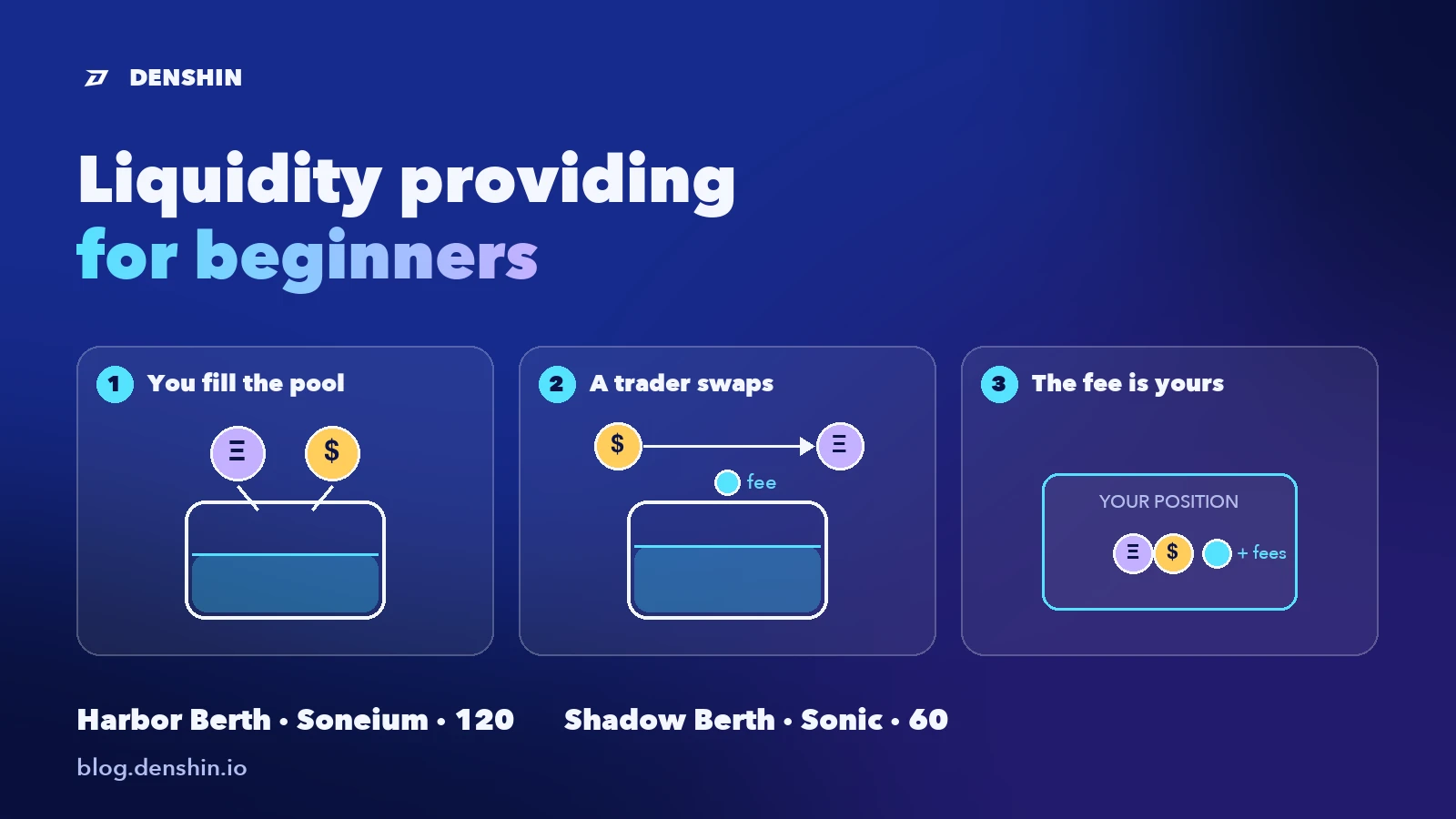
Risk, not fees. A liquidity position can come back worth less than you put in if the pair moves apart. That's impermanent loss, and no gas table shows it. It's why our LP quests have no minimum: a few cents teaches the mechanic just as well.
And the 0.10 USDC that a hold quest asks for isn't spent. It stays in your wallet.
A whole season, in gas#
Here's a rough count of the transactions behind every on-chain quest of Genesis, approvals included:
| Network | Transactions | Gas at this morning's prices |
|---|---|---|
| Base | about 12: five swap quests, three team seats, one Aave deposit, approvals | about $0.03 |
| Soneium | about 9: three swaps, a Kyo position, a deposit, a stake, approvals | about $0.05 |
| Sonic | about 4: a Shadow position, a stake, approvals | about $0.002 |
| Total | about 25 | under $0.10 |
A month of daily check-ins adds about $0.004 on Sonic, $0.02 on Base or $0.04 on Soneium.
One more number worth knowing. A season reward has one condition: at least one verified transaction, a swap a quest check accepted or a counted Denshin Sync. The cheapest way to meet it this morning was a Denshin Sync on Sonic, about a hundredth of a cent.
Small habits that keep it cheap#
- Keep a little gas on each network. A failed transaction still pays gas, and running dry halfway through is the usual reason a transaction fails.
- Leave the fee setting on default. "Fast" or "aggressive" modes overpay on networks that are rarely congested.
- Read the dollar line in the preview, not the gwei.
- Group your work. Approvals are once per token and venue, so doing related quests in one sitting saves the repeats.
How we measured, and what changes#
Gas prices came from each network's public RPC. The gas used is from transaction receipts read on public block explorers: recent swaps on Base and Soneium, Aave deposits on Base, positions on Kyo and Shadow, stakes into stS, and check-ins on our own Denshin Sync contract on all three networks. The dollar figures use one ETH and one S price, taken at the same time.
This is a snapshot, not a promise. Token prices move every day and gas spikes when a network is busy. What doesn't change is the order of magnitude: on these three networks a quest costs fractions of a cent in gas.
Every quest, its network and what its check reads are on the networks pages of our docs. The quests themselves are waiting at app.denshin.io.